The legal requirements for getting married in Malta are relatively straightforward.
The following information is intended to be a starting point and guideline only.
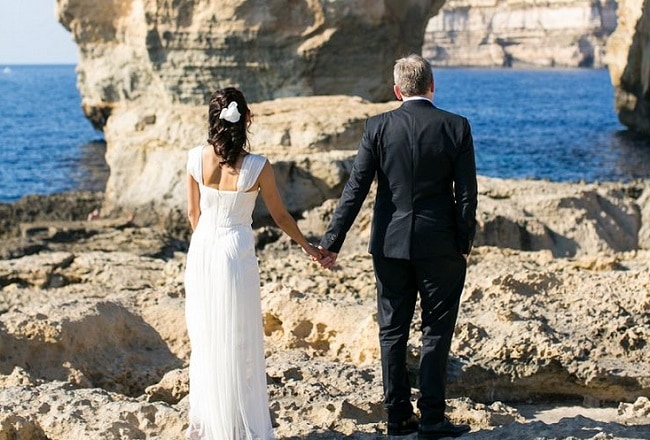
Grace & Declan’s wedding in Malta
Although much care and effort has been taken to ensure the information provided is correct please do not take it as legal advice. I strongly advise you to consult the Maltese Embassy or Consulate for first hand information on the legal requirements for getting married in Malta.
Please Note: Required documentation and the legal process may vary from nationality to nationality.
Essential Facts
- There is no minimum residency period
- Civil and religious ceremonies are legally binding
- Civil ceremonies take place in the Marriage Registry, or at authorised venues which have approval from the Registry Office
- Wedding ceremonies are conducted in English
- Your Marriage certificate is issued in English
- Same sex civil unions are legal in Malta
Legality of Marriage
Marriages performed in Malta are internationally recognised and legally binding.
Residency Requirements
There are no minimum residency requirements for getting married in Malta.
Marriage Application
In order to apply for a Marriage Application (Request for the Publication of Banns) you must complete Form RZ1 and submit it to the Marriage Registry in Valetta or Gozo together with the documentation listed below.
This applies to both civil and religious marriages.
The application must be received at least 6 weeks prior to the date of your proposed marriage but no more than 3 months before.
On arriving in Malta prior to your wedding you are required to visit the Marriage Registry in Valetta or Gozo to finalise matters. At this visit you will be required to produce your passports.
On your marriage application you need to state your intended place of marriage. If you decide to change your intended place of marriage after you have submitted your marriage application, the marriage registry will need at least three weeks notice.
If you are having a religious wedding you will also need to state the name of your priest.
Required Documentation
- Request for the Publications of the banns (Form RZ1 – download here)
- Declarations on Oath (Form RZ2 – download here)
- The declaration must be signed on separate forms by each of the parties in the presence of a Commissioner of Oaths attached to a Maltese Diplomatic Mission or in the presence of a Commissioner of Oaths (e.g. solicitor, a justice of the peace, a Notary etc), who must affix their personal stamp or seal.
- Original long Birth Certificate which include the names of both your parents
- In the event that your full birth certificate does not contain particulars of your parents, like in some of the American States, a Statutory Declaration is required from a relative or friend, who knows the parents concerned and can confirm the Full Current Names of both parents as well as the Maiden Name of the mother in writing. The friend/relative and the solicitor on his own letterhead and /or with his stamp/seal must sign the documents.
- Passport
- Photocopy is sufficient for your Marriage Application
- Original must be bought to the wedding ceremony
- If you have not been previously married
- A Free Status Certificate from your Local Registrar – .i.e. Certificate of No Impediment
- Note: The UK does not issue Certificate of No Impediment’s for marriages in Commonwealth countries, therefore UK Nationals should obtain a 3rd Party Declaration in place of this.
- If you are divorced
- Decree Absolute & previous marriage certificates
- Affidavit by a 3rd person drawn up in the presence of a solicitor, stating that since the date of your divorce, you did not re-marry
- If you are widowed
- Certificate of 1st marriage
- Death certificate of former spouse
- Affidavit by a 3rd person drawn up in the presence of a solicitor, stating that since the death of your former spouse, you did not re-marry
- If you are under 18
- Parental consent to marry
- If you have changed your name
- A notarised copy of the Deed Poll
- If you are getting married in Gozo, you will also be required to produce particulars of your witnesses and photocopies of their passport, their place of birth, residence and father’s name
Note:
- Documents which are not in Maltese or English must be translated and legally authenticated
- The Free Status Certificates and RZ2 form are only valid for 3 months
- Originals or true copies of your documents will not be returned to you
Witnesses
You must have two witnesses who are 18 years of age or over.
Certificate of Marriage
Marriage Certificates may be obtained online by application to the Public Registry: The Public Registry – Identity Malta
Hot Tips! – Plan a Wedding in Malta
I hope the above information has been a helpful starting point. On Weddings Abroad Guide we promote the services of some fantastic wedding planners who can help you create a unique wedding day that reflects your individual style and personality. To connect with wedding planners in one easy step use the form below and your enquiry will be forwarded to at least 5 wedding planners who work in Malta. Click here to learn more.
Find a Wedding Planner in Malta
Additional Details
For more information on the type of wedding ceremony you may have in Malta click here.
For information in respect of same-sex marriages in Malta click here.
Further Information
For further information, application forms, the most up-to-date legal requirements for getting married in Malta please contact any of the following.
The Public Registry of Malta
pubreg.marriage@gov.mt
Tel: (+356) 25904200 (Reception)
The Public Registry of Gozo
pubreg.mgoz@gov.mt
Tel: (+356) 22156381
Email: pubreg.marriage@gov.mt
In addition, contact the Maltese Embassy, High Commission or Consulate in your country of residence.
A full listing of Maltese Diplomatic Missions and Consular Offices can be found on the following link: Maltese Embassy or Diplomatic Mission in your country
I would highly recommend you employ the services of a Wedding Planner or Malta Travel Specialist to help deal with the paperwork and legalities. If you choose to make an application for a wedding licence yourself, you will need to make provisions to ensure your documentation is correctly submitted and lodged on time.
Getting Married in Malta – First Steps

Is there anything wrong with this page? Let us know here. We are grateful for you helping us to keep the information up to date.
Requirements are subject to change in accordance with the laws of Malta. Information updated as of Jan 2016